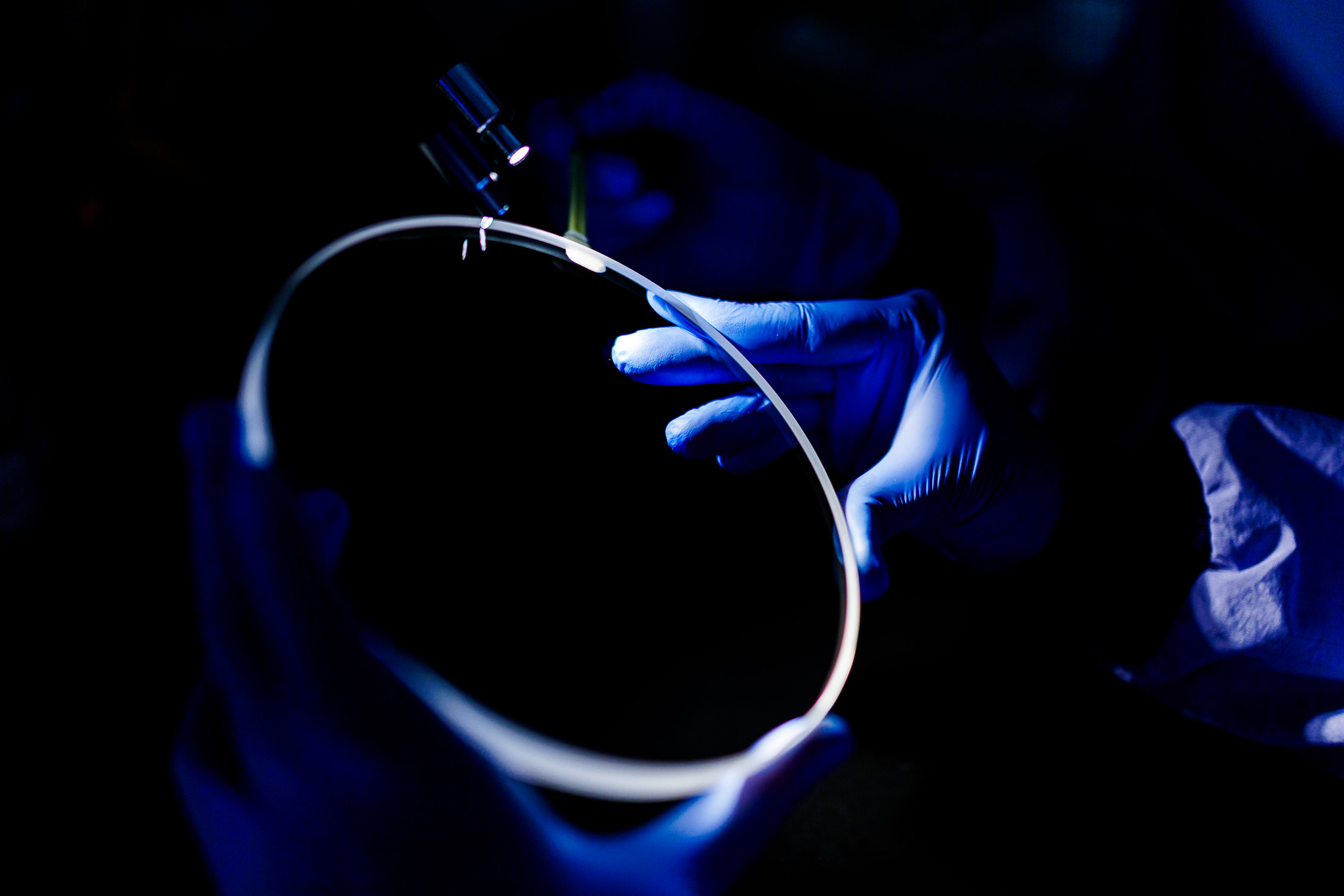
Laser cutting is used for high-speed, precision separation of metals and non-metals, delivering superior edge quality and minimal thermal distortion compared to mechanical methods. These systems typically operate at 1.03–1.07 µm (fiber or Nd:YAG lasers) or 10.6 µm (CO₂ lasers) and can run in continuous-wave (CW) mode for thick materials or nanosecond pulses or even shorter femtosecond pulses for fine cutting. Critical optical components include beam delivery optics, focusing lenses, and protective windows with high-damage-threshold coatings to ensure consistent performance under intense thermal loads.
Industrial

Photonics, the science and technology of light, plays a pivotal role in modern industrial processes, enabling precision, speed, and efficiency across manufacturing, quality control, and automation. Industries increasingly adopt photonic solutions because they deliver non-contact measurement, high accuracy, and real-time monitoring essential for productivity and cost effectiveness.
From laser cutting and welding to optical inspection and sensing, photonics empowers processes that reduce material waste, improve throughput, and ensure consistent quality.
Altechna supplies high-performance laser optics and optomechanical assemblies that are immune to electromagnetic interference, support high-speed operation, and integrate seamlessly into automated production lines.
Optics & Optomechanics
Engineered for industrial laser systems
Laser Cutting Systems
Laser Welding Systems
Laser welding enables deep, narrow welds with minimal heat-affected zones, outperforming conventional welding by reducing distortion and supporting automation. Common wavelengths are near-infrared (1.03–1.07 µm) for metals and green (~515 nm) for reflective materials, with systems operating in CW mode for deep penetration or nanosecond pulses for precision spot welding. Essential optics include collimating lenses, beam shaping elements, fiber delivery systems, and protective windows designed for high-power stability.
Material processing and surface treatment systems
Laser-based material processing and surface treatment provide precise control for hardening, texturing, and coating removal, eliminating mechanical wear and chemical waste. Typical wavelengths range from UV (355 nm) for microstructuring to IR (1.03–1.07 µm) for thermal treatments, with ultrashort pulses (femtosecond and picosecond) used for cold ablation and nanosecond pulses for marking and engraving. Key optical components include beam homogenizers, scanning mirrors, focusing optics, and coatings optimized for high repetition rates to maintain beam quality and durability.
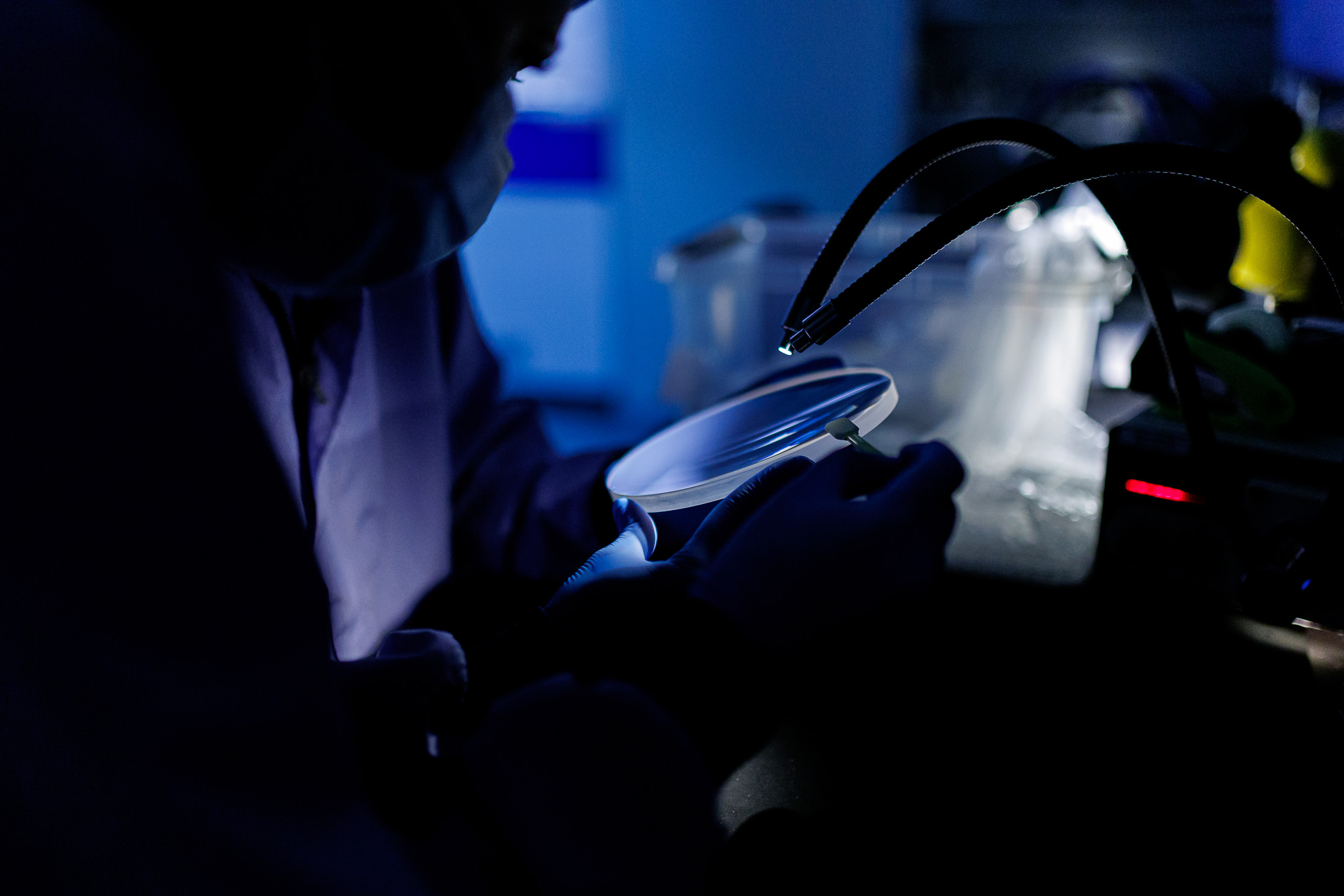
criteria
Critical performance criteria
Contamination Resistance
Protective windows and coatings must resist spatter, fumes, and debris generated during processing. Durable, easy-to-clean surfaces extend component life and maintain consistent optical performance.
High Damage Threshold
Industrial lasers often operate at very high power levels or energy densities, so optics must withstand intense thermal and mechanical stress without degradation. This ensures uninterrupted operation and prevents costly downtime in demanding environments.
Excellent Beam Quality
Optical components must preserve beam shape and focus to achieve precise cuts, welds, and surface treatments. Good beam quality directly impacts process accuracy, edge smoothness, and overall production efficiency.
Thermal and Mechanical Stability
Optics should maintain alignment and performance under continuous exposure to heat and vibration from industrial machinery. Stability is critical for automated systems where even minor shifts can compromise quality.
Solutions
Our solution tailored for industrial application
High-power collimators
Compatible
with industry standard fiber connecters (QBH fiber input up to 15 kW)
Nitrogen purge
for high throughput
Adjustable
collimation
Robust
stainless-steel housing
Active alignment
lens design
Close to to diffraction limited design of
RMS wavefront <0.02λ on axis, reduced to <0.046λ over 2° full angle FOV, Strehl ratio 0.985 over full aperture
High-Power mirrors for 1 µm range

Coating performance
R>99.99% at 1 µm
Flatness and WFD
<L/10 @633 nm
Surface quality (srcatch-dig, per MIL)
10-5
Durability
per MIL-C-48497A and MIL-F-48616 (abrasion, adhesion, temperature, solubility and cleanability)
Coated optics absorption
<1 ppm
LIDT
94.5 J/cm² @1064, 10 ns, 100 Hz, 1000-on-1
1.11 J/cm² @1030, 500 fs, 200 kHz, 10M-on-1
>31.4 MW/cm² (>327 kW/cm) @1070, CW, Raster Scan, (undamaged under max testing power)
High-Power lenses & windows for 1 µm range

Coating performance
R<0.05% at 1 µm
Flatness and WFD
<L/10 @633 nm
Surface quality (srcatch-dig, per MIL)
10-5
Durability
per MIL-C-48497A and MIL-F-48616 (abrasion, adhesion, temperature, solubility and cleanability)
Coated optics absorption
<1 ppm
LIDT
>50 J/cm² @1064, 10 ns, 100 Hz, 1000-on-1
1.19 J/cm² @1030, 300 fs, 200 kHz, 10M-on-1
>31.4 MW/cm² (>327 kW/cm) @1070, CW, Raster Scan, (undamaged under max testing power)
High-Power fiber end-caps

Spectral performance
R<0.05% at 1 µm
Durability per
MIL-C-48497A (abrasion and adhesion)
MIL-F-48616 (temperature, solubility & cleanability)
Absorption
<1 ppm @1070 nm, PCI
Surface quality (srcatch-dig, per MIL)
10-5
LIDT
>31.4 MW/cm² (>327 kW/cm) @1070, CW, Raster Scan, (undamaged under max testing power)


