Alexandrite Laser Crystals for Satellite LiDAR: The Key to High-Precision Atmospheric Monitoring

Developing a European Supply Chain for Space-Grade Alexandrite Crystals
Companies from Lithuania, Italy, and Germany reached a new milestone for independent European space missions. During the GALACTIC project, they developed a European supply chain of Alexandrite laser crystals for studying changes in the atmosphere and the planet’s surface.
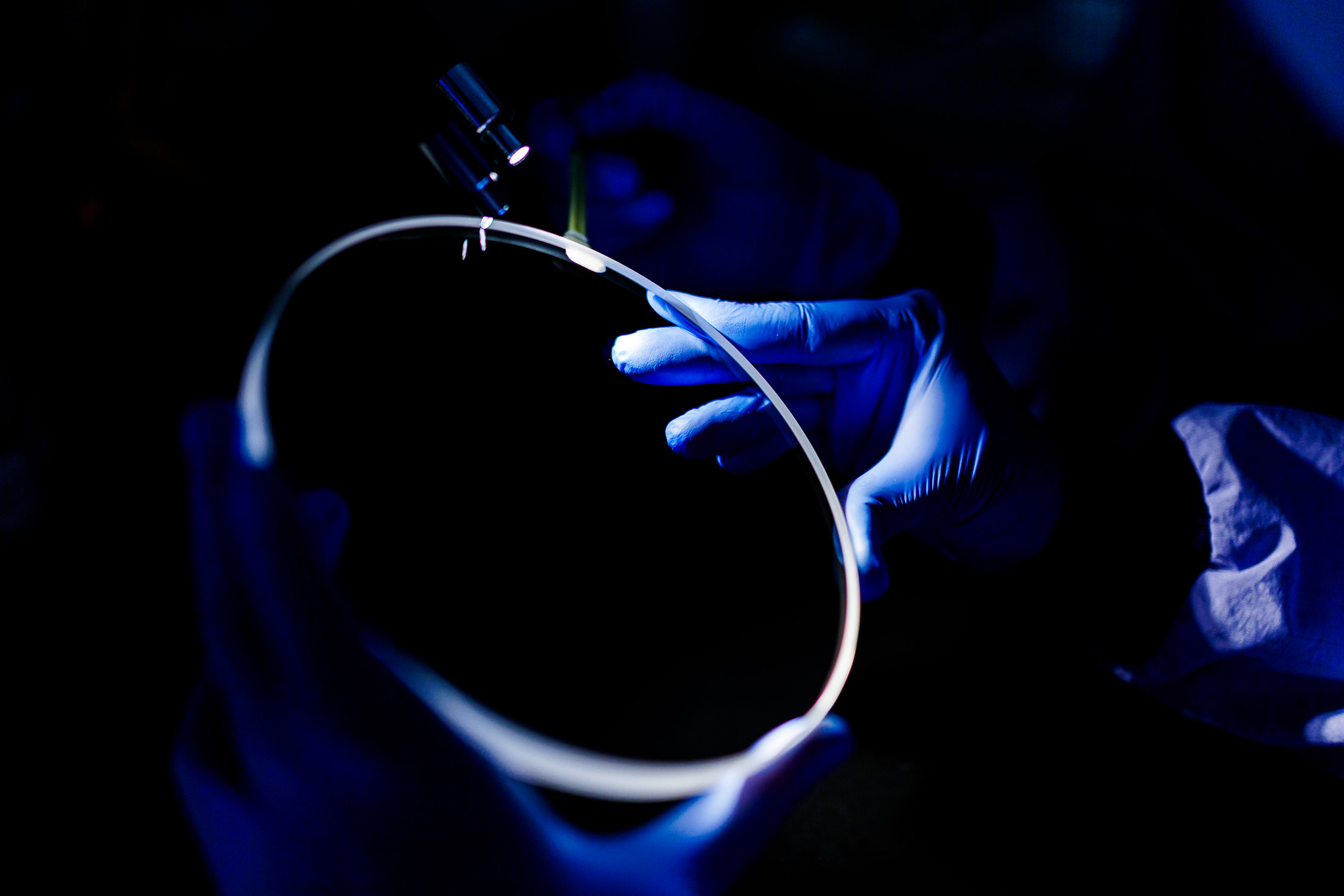
The high-power Alexandrite crystals and coatings developed in the GALACTIC project will be used to collect climate change-related observations on the atmosphere and vegetation. The goal is to employ such laser crystals in systems used in satellite-based LiDAR devices for shoreline mapping, storm surge modeling, and seafloor measuring.
Alexandrite Lasers for Atmospheric Monitoring
“Droughts, heatwaves, and floods cause more and more losses every year. Gladly, LIDAR instruments with Alexandrite lasers help us to detect atmospheric changes. Lasers’ near-infrared wavelengths enable precise studies for atmospheric gases, aerosols, clouds, their movement, and temperature,” said Antanas Laurutis, CEO of Altechna, involved in the project. “LIDARs enable detailed analysis of aerosols, clouds, and atmospheric composition, resulting in better climate change predictions.”
Alexandrite is valuable for LIDAR technology as it can adjust its light wavelength in a certain range for laser applications, around 700 to 860 nanometers. This adaptability is vital for technologies like Raman and Differential Absorption lidars (DIAL) used in studying our atmosphere. Raman lidars spot molecules by their unique light patterns, while DIAL systems identify gases like SO₂, NOₓ, and HCl, known for causing acid rain.
Strategic Importance for European Space Missions
The purpose of the Horizon 2020 project GALACTIC was to develop reproducible, fully European supplier-based coated Alexandrite crystals. In 2022, EU officials announced space as a strategic focus within the Strategic Compass, emphasizing the need for an EU Space Strategy focused on Security and Defence.
“Space is a strategic area for Europe and the supply chain developed during the GALACTIC will allow space missions to be carried out independently of other regions,” said Laurutis. “Europe will also avoid export controls that often make such projects difficult.”

Credit: GALACTIC
Optical Coatings and Technology Validation
Altechna, one of the leading optical engineering companies in the EU, contributed to the development of specific coating designs and processes with e-beam and reactive magnetron sputtering equipment.
“European crystals were studied while comparing with the ones made by the world’s top suppliers, mainly the U.S. and Chinese companies. The tests showed that the GALACTIC crystals are at least the same quality as non-European technological solutions,” says Laurynas Lukoševičius, Altechna’s chief scientist. “That is the big step of Europe’s independence for laser technologies in space missions.”
TRL 6 Qualification for Space Applications
The new European technology passes a verification of TRL 6, generally used in space.
“TRL 6’s space-qualified coated Alexandrite laser crystals are a key technology enabling future Earth observation missions. Together with our partners, we are developing an advanced laser prototype that will enable Europe to get more accurate data from atmospheric research,” says Lukoševičius. “For example, using LIDAR instruments with Alexandrite lasers, we could help better identify cloud types and prepare for severe weather conditions.”
Project Scope and European Collaboration
The total value of the GALACTIC project amounts to €1,999,127.50. The European Union-funded initiative started on 1 January 2020.
The GALACTIC project was implemented by three European companies: Altechna (Lithuania), Optomaterials S.r.l. (Italy), and Laser Zentrum Hannover e.V. (Germany), which led the whole GALACTIC project.
Ongoing Research and International Expansion
Altechna is also contributing to the ongoing EU project EULIAA, which aims to develop an autonomous lidar array measuring system that could compute the atmospheric wind and temperature from 5 to 50 kilometers. This system should work on a 24/7 basis for at least one year without maintenance and cover an observation area of up to 10,000 square kilometers. New LIDAR units help to get more precise atmospheric physics data like wind and temperature distributions in the atmosphere.
The company has recently acquired Alpine Research Optics, based in Colorado. The acquisition will strengthen Altechna’s role in the American market, with the U.S. revenues from both companies accounting for around 50% of the group’s consolidated sales.