From Early Tests to Arctic Deployment: Progress Inside Europe’s EULIAA Atmospheric LiDAR Project
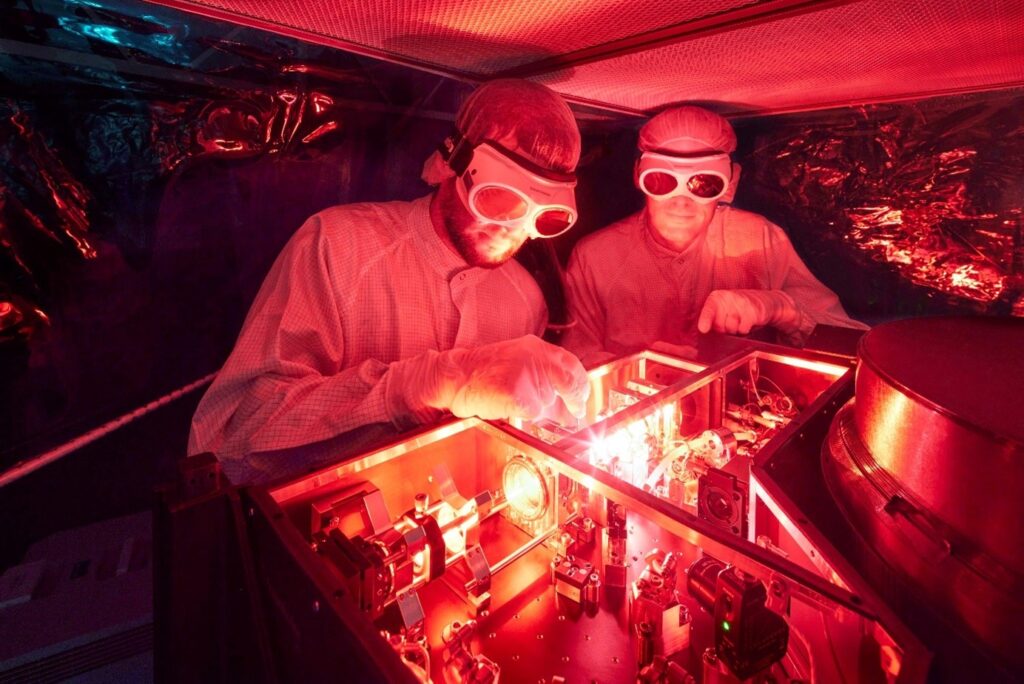
A European Collaboration for Atmospheric Monitoring
EULIAA (European LiDAR Array for Atmospheric Climate Monitoring) brings together seven European partners to develop, test, and deploy an advanced, mobile LiDAR system designed for long-term, automated operation. The consortium combines industrial, research, and infrastructure expertise, including:
- Altechna
- Fraunhofer ILT (project lead)
- Leibniz Institute of Atmospheric Physics
- Andøya Space
- MeteoSchweiz
- LATMOS
- GORDIEN STRATO
The shared objective is to establish a robust, fully European LiDAR capability that can deliver reliable wind and aerosol data for operational use and climate research.
Early Testing and System Validation
Initial system tests earlier this year confirmed strong performance even during the development phase. The LiDAR successfully detected atmospheric signals up to 65 km altitude, and depolarisation measurements were achieved thanks to the optical design and coating performance of the lenses.
An important practical detail is that these early measurements were carried out through a laboratory window. This approach allowed rapid optimisation and iteration – a significant advantage, as modifications become far more complex once the system is deployed to remote locations such as Arctic stations or mountain observatories.
First Operational Deployment in the Arctic
A major milestone has now been reached with the deployment of the first EULIAA atmospheric LiDAR system at the Arctic Lidar Observatory for Middle Atmospheric Research in Norway, approximately 300 km north of the Arctic Circle.
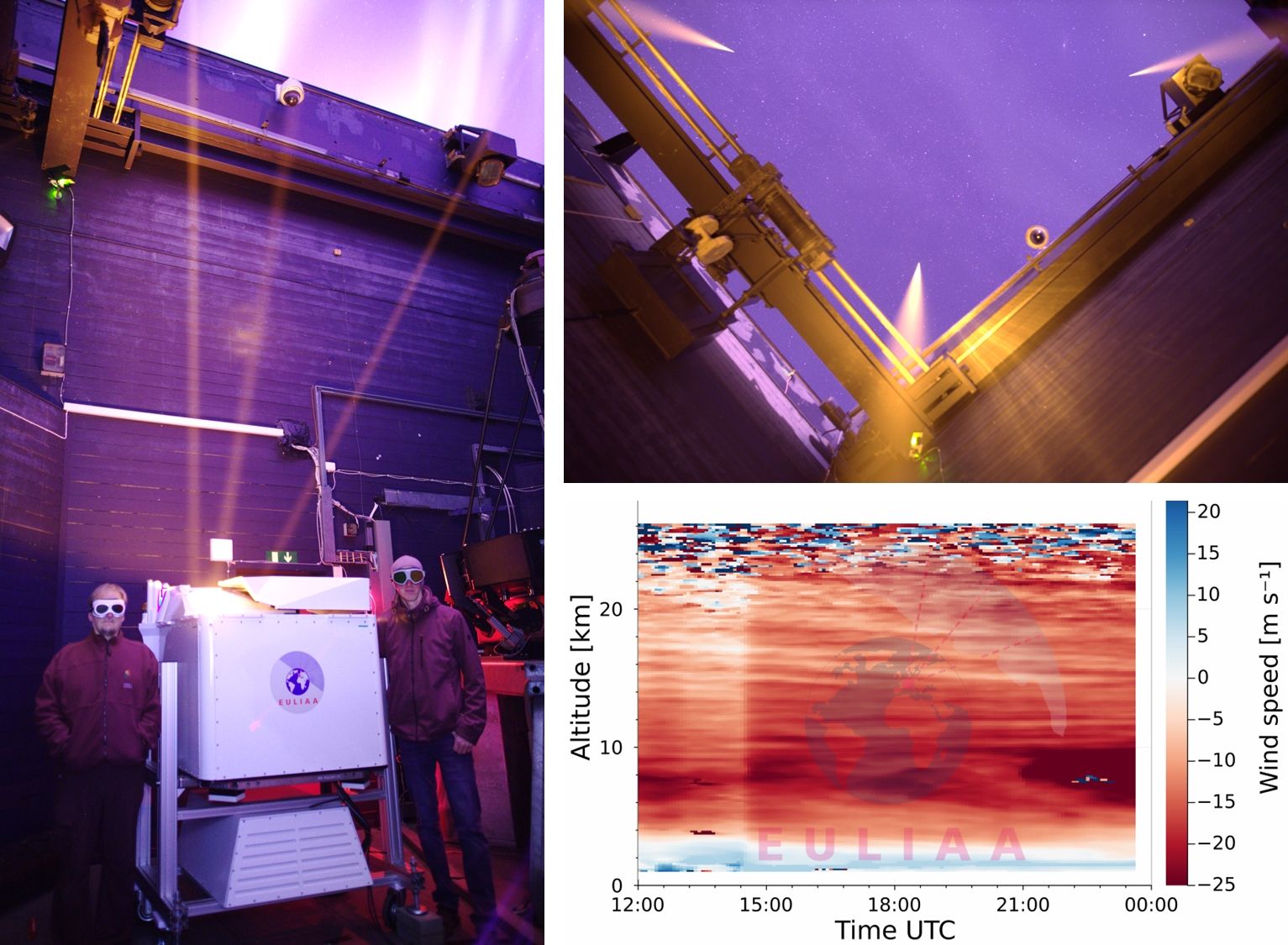
Images: Leibniz IAP
The system is already delivering real-time wind measurements up to 20 km altitude, with full-scale, automated, and multi-angle measurements now underway. Early operation has shown that the system functions reliably under daylight, polar weather, and auroral conditions, confirming its suitability for continuous monitoring at high latitudes.
Optical Engineering Contributions
At this stage of the project, Altechna has contributed optical engineering and manufacturing expertise focused on durability, spectral precision, and long-term stability. Contributions include:
- High-damage-resistance optics for UV laser emission
- Narrow bandpass filters with sharp spectral selectivity
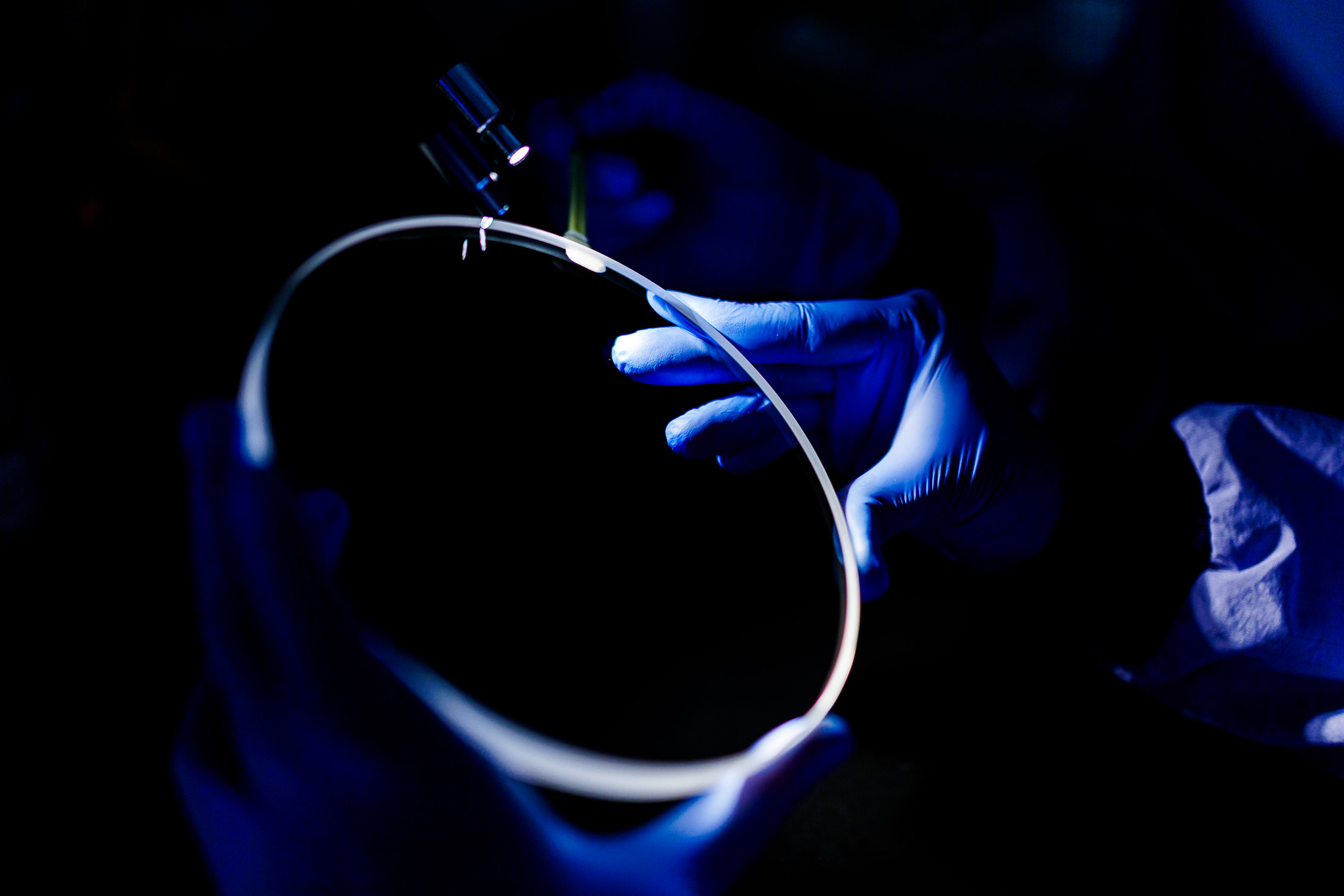
- Large-aperture telescope optics, including BK7 substrates up to 250 mm in diameter
Surface cleaning and finishing were carried out prior to coating, a critical step to ensure layer quality and performance. Protective optical windows with solar-rejection properties were also produced for the LiDAR telescope, helping to maintain low internal temperatures and stable laser signals under varying environmental conditions.
Designed for Mobility Across Europe
Over the coming year, two mobile LiDAR units will be deployed across a wide range of environments – from the Swiss Alps and the French Mediterranean to the volcanic highlands of Tenerife. Data from these deployments will be streamed in near real time into Copernicus and other open climate platforms, supporting improved weather models and a deeper understanding of the upper atmosphere.
As EULIAA progresses into its next phase, the project continues to demonstrate how precise laser optics, rigorous testing, and coordinated European collaboration can enable reliable atmospheric research – from the Arctic Circle to equatorial regions.