Whitepaper: Optical Components for Medical Er:YAG Lasers – Advanced Coating Strategies and Material Solutions for 2940 nm Applications
Over the past few decades, lasers have become indispensable tools across a wide range of applications. By selecting the right system and optimizing its parameters, professionals can address diverse technological challenges with maximum efficiency. Here we are going to address lasers operating near 3 μm, which are particularly valued for their unique interaction with water, whose absorption increases sharply between 1.2 and 3 μm (Figure 1).
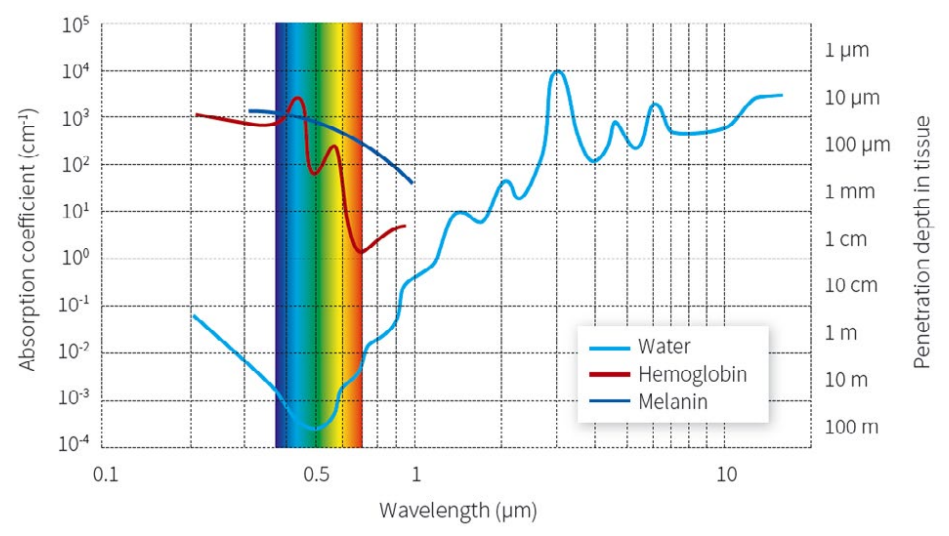
Figure 1. Absorption and penetration depth in water and other biological tissue constituents for different wavelengths [1].
At 2940 nm, Er:YAG lasers deliver exceptional efficiency for controlled ablation with minimal thermal damage, making them well-suited for procedures in dermatology, dentistry, and minimally invasive surgery.
Studies confirm that wavelength plays a decisive role in tissue interaction. While Er:Glass and CO₂ laser systems are widely used in dermatology, Er:YAG lasers at 2940 nm exhibit superior performance for controlled ablation with minimal thermal damage. At comparable power levels, Er:YAG systems deliver shallower penetration yet achieve higher removal rates of outer tissue layers. Additionally, Er:YAG lasers offer versatile pulsed operation modes – such as long-pulse, super-pulse, and Q-switched configurations – often implemented with electrooptical or acousto-optical modulators. Their ability to finely tune pulse duration and energy delivery provides exceptional process control for both surgical and aesthetic applications.
In both direct and endoscopic surgery, two critical factors dominate: coagulation and ablation depth. Small coagulation zones help minimize bleeding and improve outcomes, whereas excessive thermal spread can compromise tissue functionality. Precise control over ablation depth and thermal effects is essential for achieving high accuracy in delicate interventions.
However, due to the strong water absorption at 2940 nm, Er:YAG lasers cannot be used with standard, inexpensive, flexible, and biocompatible silica optical fibers [2]. This limitation makes them unsuitable for endoscopic applications, where fiber delivery is typically required, and instead favors the use of articulated delivery arms with optical components. Also, the same strong water absorption at 2940 nm makes Er:YAG lasers one of the most preferred tools for minimally invasive medical procedures.
Designing Beam-Delivery Optics for 3 µm Systems
As previously mentioned, Er:YAG lasers exhibit strong absorption in water, which can also affect substrates, coatings, and optical components if they are not properly treated. Hydroxyl (–OH) groups present on substrate surfaces, inside coating and coating chambers pose a significant challenge for high-performance 2940 nm coatings. These groups originate from adsorbed water and act as strong absorption centers in the mid-infrared, leading to increased optical losses and reduced laser damage resistance – critical parameters for Er:YAG laser applications. If not properly controlled, OH contamination can migrate into the coating stack, degrading both spectral performance and long-term reliability. There is no single, universal solution to mitigate the impact of water. Instead, an integrated approach is required, combining optimized coating deposition conditions, appropriate substrate selection, and precise control of process parameters.
Coating systems equipped with a load-lock chamber (i.e., additional vacuum unit for controlled substrate transfer and reduced contamination) provide a critical advantage for mitigating this problem. By allowing substrates to enter the vacuum chamber without frequent exposure to ambient air, the load-lock minimizes re-adsorption of water and formation of hydroxyl groups on the main chamber surfaces. The load-lock allows the system to sustain a starting chamber pressure significantly lower than that of systems lacking a load-lock, thereby removing the need for extended and inefficient pumping cycles. This controlled transfer ensures a cleaner environment and reduces the risk of OH contamination during the entire coating process.
Complementing this, ion-plasma treatment prior to deposition enhances coating quality by actively removing residual OH groups from the substrate, improving adhesion and densifying the initial layers during deposition. Together, these measures create a chemically stable interface, resulting in lower absorption, higher durability, and superior optical performance for demanding mid-infrared applications.
Optical Components
As discussed earlier, the coating system configuration significantly impacts the performance of optical components operating with Er:YAG lasers. However, the composition of the optical component itself – such as substrate material, its roughness, and coating precision – has an even greater influence on its final performance within a laser system.
Choosing Durable IR Materials
Fused silica performs exceptionally well in near-IR applications; however, for transmissive optics, its strong OH absorption makes it unsuitable for wavelengths beyond approximately 2.6 μm. Even the best infrared-optimized fused silica, with OH concentrations as low as <1 ppm, exhibits poor transmission at 2940 nm. Therefore, for transmissive optics operating in this wavelength range, materials such as sapphire, CaF₂, or ZnSe works better.
While spectral performance is critical, chemical and mechanical stability is equally important for medical applications, where optical components must withstand repeated chemical or thermal sterilization. CaF₂, although spectrally suitable, is relatively soft and prone to mechanical damage. ZnSe offers good optical properties but is sensitive to moisture and acids. Sapphire, on the other hand, combines excellent spectral performance with superior mechanical and chemical durability, making it the preferred choice for medical applications.
Impact of Surface Roughness
Substrate and coating roughness are critical parameters because water molecules trapped in porous coatings or adsorbed on rough surfaces act as absorption centers for Er:YAG lasers and can cause damage initiation points during irradiation. While minimal surface roughness does not directly indicate water content in the coating, it strongly correlates with coating integrity and water-free performance.
Optical Stability and Monitoring
Another challenge in precision coating processes is efficient spectral monitoring. Most conventional coating deposition systems cannot directly monitor coatings optimized for ~3 μm wavelengths due to detector limitations. Typically, monitoring occurs in the 300–1100 nm range, and in some cases up to 1750 nm. This limitation requires coating engineers to have a deep understanding of material properties and deposition behavior to simulate and implement precise coatings for 2940 nm – a state-of-the-art approach.
Altechna‘s solution for Er:YAG and similar laser optics
Delivering reliable optical components for mid-infrared applications requires not only advanced coating technology but also precise material processing and surface preparation. Altechna has developed and validated processing procedures for a range of 3 μm transmissive materials – including sapphire, and CaF₂ – both before and after coating, ensuring optimal performance and long-term reliability. Our sapphire substrates feature an initial surface roughness of just 1.5 Å, and thanks to our high-energy sputtering technology, this value remains unchanged even after depositing coatings up to 3-10 μm -thick – guaranteeing exceptional optical integrity (Figure 2). To achieve industry-leading performance, Altechna leverages more than 29 years of coating expertise combined with advanced tools such as the Bühler Helios 800 magnetron sputtering system. This system is equipped with a load-lock chamber and ion-assisted deposition capabilities, which are critical for producing dense, water-free coatings with negligible levels of hydroxyl (–OH) groups. By eliminating OH contamination – one of the main absorption centers in the mid-infrared – our coatings deliver laser-induced damage thresholds (LIDTs) well above market standards, ensuring superior durability under high-power Er:YAG operation.
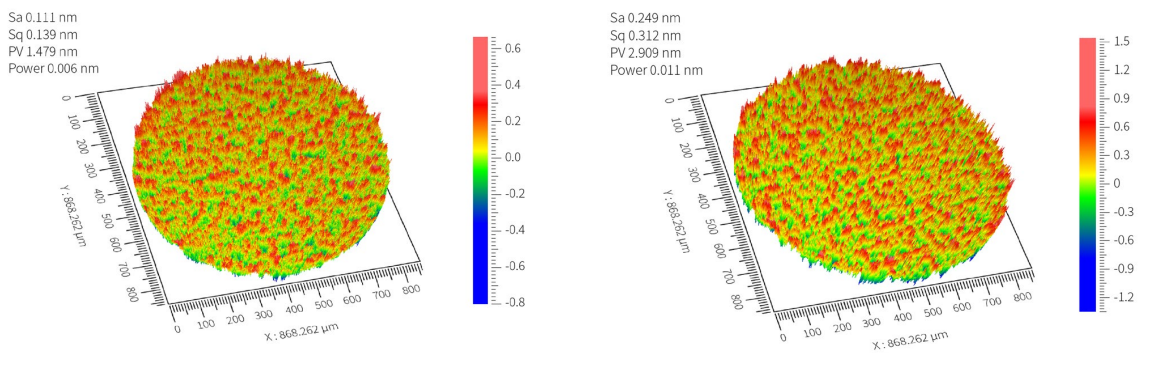
Figure 2. Surface roughness of a) Aiming Mirror on Sapphire and b) Turning Mirror on FS.
High LIDT Targeting Mirrors and Antireflective Optics
- MID-IR Glass: Sapphire, CaF₂
- Low surface roughness: <3 Å
- Dielectric moisture-resistant coating
- SQ per MIL: 20/10
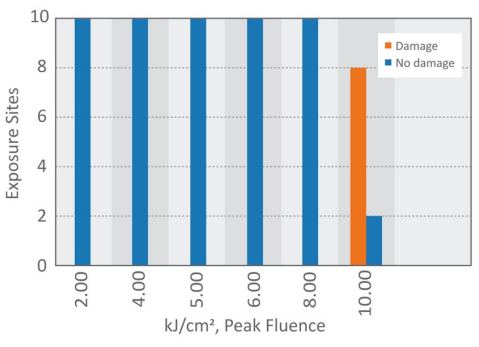
- LIDT > 4000 J/cm² @ 2940 nm, 300 μs, 2 Hz (equivalent of > 400 GW/cm²)
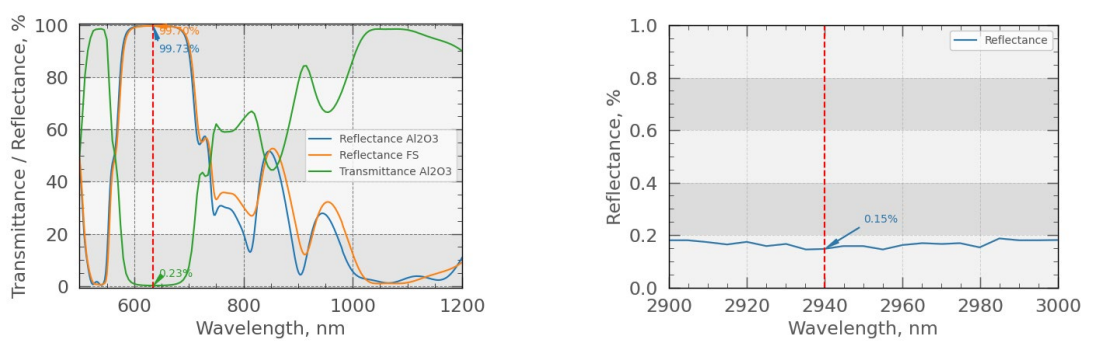
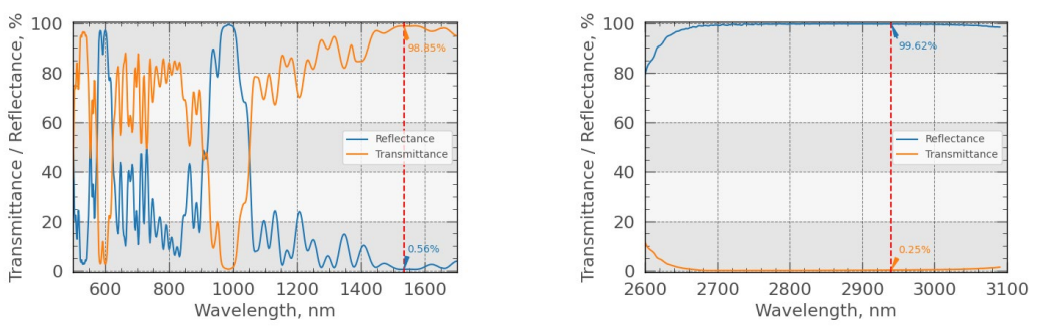
- HR > 99.7% @ 635 nm + HT > 99% @ 532 + 1064 + 2940 nm, AOI 45°
- AR (R) < 0.1% @ 2940 nm, AOI 45°
High LIDT Turning Mirrors for Articulated Arms
- Any high-quality substrate material: Sapphire, CaF₂, FS
- Low surface roughness: <3 Å
- Dielectric moisture-resistant coating
- SQ per MIL: 20/10
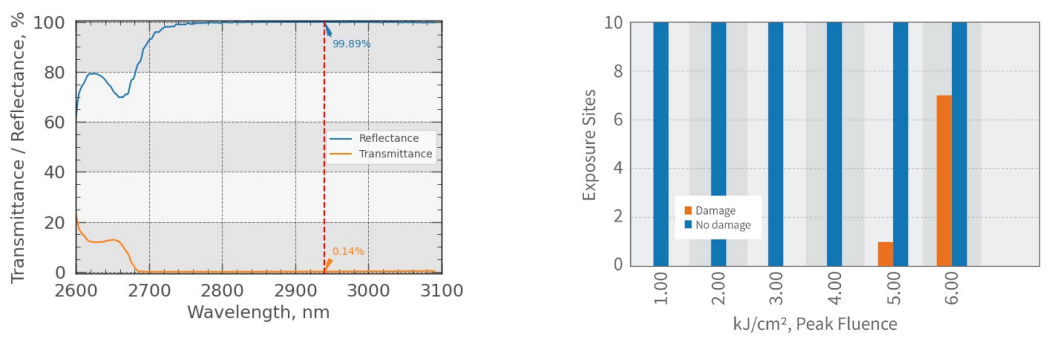
- LIDT > 8000 J/cm² @ 2940 nm, 300 μs, 2 Hz (equivalent of > 800 GW/cm²)
- HR > 99.9% @ 2940 nm, AOI 0-45°
High LIDT Pumping Mirrors
- Any high-quality substrate material: Sapphire, CaF₂, FS
- Low surface roughness: <3 Å
- Dielectric moisture-resistant coating
- SQ per MIL: 20/10
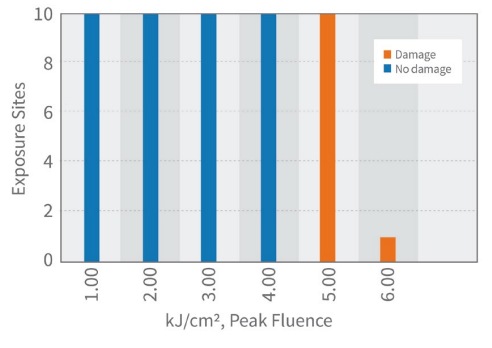
- LIDT > 4000 J/cm² @ 2940 nm, 300 μs, 2 Hz (equivalent of > 400 GW/cm²)
- HR > 99.5% @ 2940 nm + HR > 85% @ 589 nm + HT > 98% @ 1535-1540 nm + HT > 95% @ 532 nm, AOI 45°
Order today
Altechna provides solutions for a wide range of optical components used in dermatology and medical laser systems, including windows, lenses, and complex geometry optics. For expert assistance, feel free to contact our team at [email protected].
References
- Frontiers in Guided Wave Optics and Optoelectronics, Book edited by: Bishnu, P., ISBN 978-953-7619-82-4, p. 674, February 2010, INTECH2. Nathaniel, M. Fried, Recent advances in infrared laser lithotripsy, Biomed. Opt. Express 9, 4552-4568 (2018)
- Lukoševičius, L. et al., Investigation of LIDT and spectral performance of coatings for high-power Er:YAG laser applications, SPIE Laser Damage, Proc. SPIE PC13729 (2025)